BlueprintBlueprint
Every decision a product needs, from idea to exit, on one map — with a recommended pick, its reason, and the options it beat.アイデアから撤退まで、プロダクトに要る決断を 1 枚の地図に。おすすめの案と理由、負けた選択肢まで付けて。
See it on GitHubGitHub で見るChallenge課題
AI can build a screen or a feature in minutes. What it cannot see is the whole product: which database, which sign-in, which payment provider, which rules for refunds and privacy, and what breaks when one of those changes. Founders find out late, and a late U-turn costs weeks.AI は画面や機能を数分で作れる。見えないのはプロダクト全体だ。どのデータベースか、どのログインか、どの決済か、返金やプライバシーのルールはどうするか、そして 1 つ変えたら何が壊れるか。創業者は遅れて気づき、遅いやり直しは何週間も食う。
Solution解決
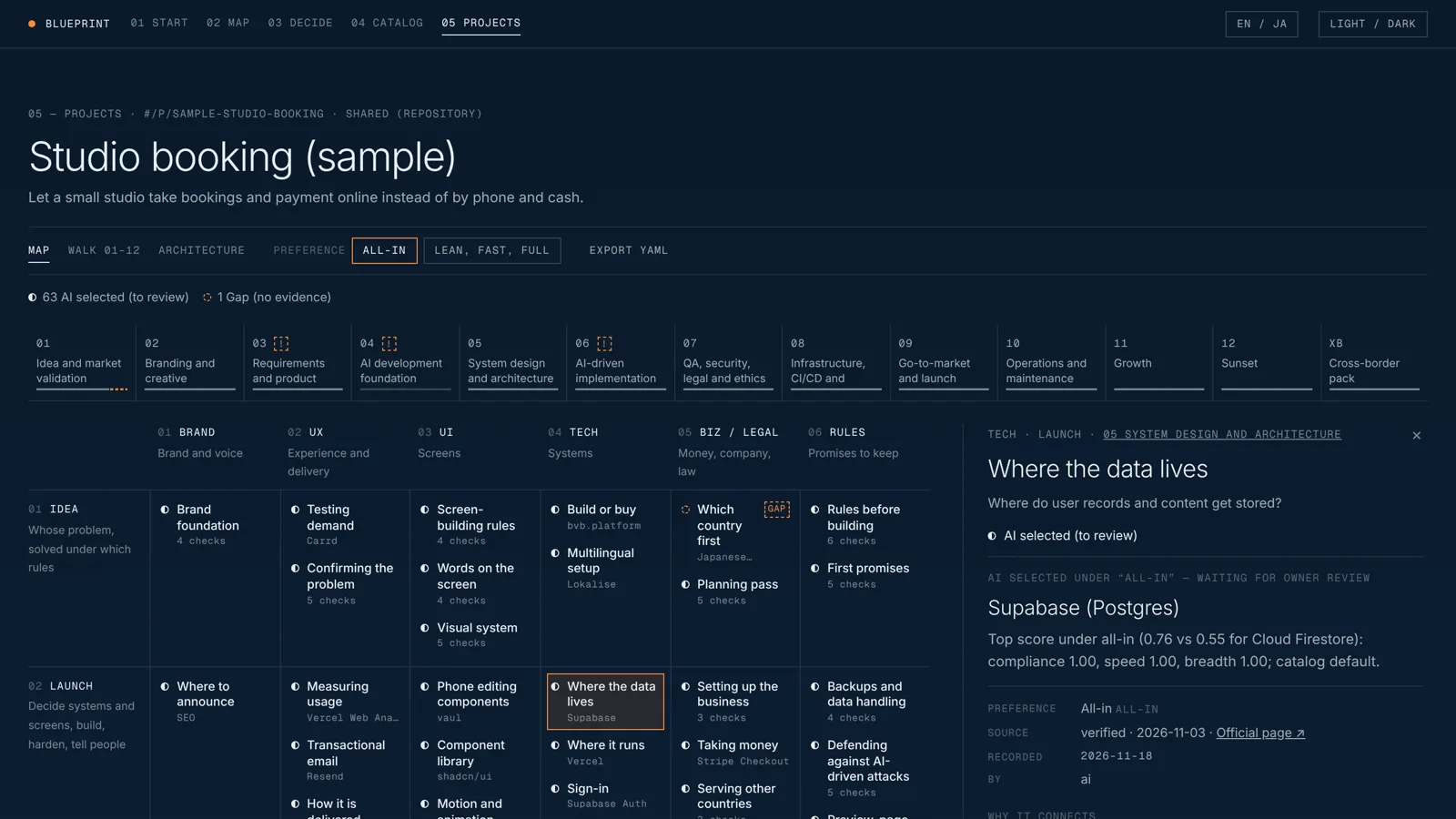
I laid every decision out on one map — 64 decisions in five stages and six lanes — and attached to each one the options, one recommended pick with its reason, free tiers and limits, and what it depends on. A catalog of 607 sourced items backs the picks. People review the map in a web app; AI agents read and update the same map through an MCP server. An agent can propose; only the owner decides.決断をすべて 1 枚の地図に並べた。5 つの段階と 6 つの列に 64 の決断。それぞれに選択肢、おすすめ 1 つとその理由、無料枠と上限、何に依存するかを付けた。おすすめの裏には、出典つきの 607 項目のカタログがある。人はウェブアプリで地図を見直し、AI エージェントは MCP サーバーから同じ地図を読み書きする。エージェントは提案まで。決めるのは持ち主だけ。
Impactインパクト
I turned launch planning into one decision map that a founder and an AI agent read from the same files.立ち上げの計画を 1 枚の決断の地図にし、創業者と AI エージェントが同じファイルから読めるようにした。
Four questions, then the whole product on one map 4 つの質問のあと、プロダクト全体が 1 枚の地図に
A founder who does not code starts with a name, a one-line goal, who it is for and where it is used. Every decision the product will need then appears on one map: 64 decisions across five stages — idea, launch, operate, scale, exit — and six lanes — brand, UX, UI, tech, business and legal, and rules. The lines on the map are real dependencies only, so the map shows what has to be settled before what. コードを書かない創業者は、名前、一行のゴール、誰のためか、どこで使うかから始める。するとプロダクトに要る決断が 1 枚の地図に並ぶ。アイデア・立ち上げ・運用・成長・撤退の 5 段階と、ブランド・UX・UI・技術・ビジネスと法務・ルールの 6 列に、64 の決断。地図の線は本当の依存関係だけなので、何を先に決めるべきかが見える。


Every pick shows its reason, and what it beat どのおすすめにも、理由と負けた案が付いている
Open any decision and Blueprint shows the realistic field, not one answer: each option scored on cost and free tiers, build speed, breadth, lock-in, scale, compliance and fit with what is already chosen, with the evidence behind every score. It names the pick, why it won, a short reason for each rejected option, and how it connects to other choices — same vendor as the database, a shared free tier to watch. A missing source shows up as a visible gap instead of a guess, and prices are never asserted from memory: all 607 catalog items carry a source and the date they were checked. どの決断を開いても、答えは 1 つではなく、現実的な候補が並ぶ。費用と無料枠、作る速さ、試せる幅、ロックイン、規模、法令、すでに選んだものとの相性で、案ごとに点数を付け、どの点数にも根拠を添える。勝った案とその理由、負けた案それぞれの短い理由、ほかの選択とのつながり(データベースと同じ会社、共有の無料枠に注意、など)も出す。出典がなければ推測せず「すき間」として見せ、料金は記憶で書かない。カタログの 607 項目すべてに、出典と確認した日付がある。

The plan a person approves is the plan the agent builds from 人が認めた計画が、そのまま AI エージェントの設計図になる
The same map is open to AI agents through an MCP server with 21 tools. An agent in Claude Code or Cursor can draft a project map, ask decide for a scored pick, and record it with update_project_map, which returns a link the owner can review later. The rule is built into the server: an agent may mark a choice “AI selected” and move on, but only the owner can mark it “decided”. The architecture view draws what the picks add up to — front end, back end, data, sign-in, payments and third-party services — with what is already built drawn apart from what is only proposed.
同じ地図は、21 のツールを持つ MCP サーバーを通して AI エージェントにも開いている。Claude Code や Cursor のエージェントは、プロジェクトの地図の下書きを作り、decide で採点つきのおすすめを受け取り、update_project_map で記録する。記録すると、持ち主があとで見直せるリンクが返る。決まりはサーバーに組み込んである。エージェントは「AI が選んだ」として先へ進めるが、「決定」にできるのは持ち主だけ。アーキテクチャの画面では、選んだものを積み上げた全体像(フロントエンド、バックエンド、データ、ログイン、決済、外部サービス)を、作ったものと提案だけのものを分けて描く。
